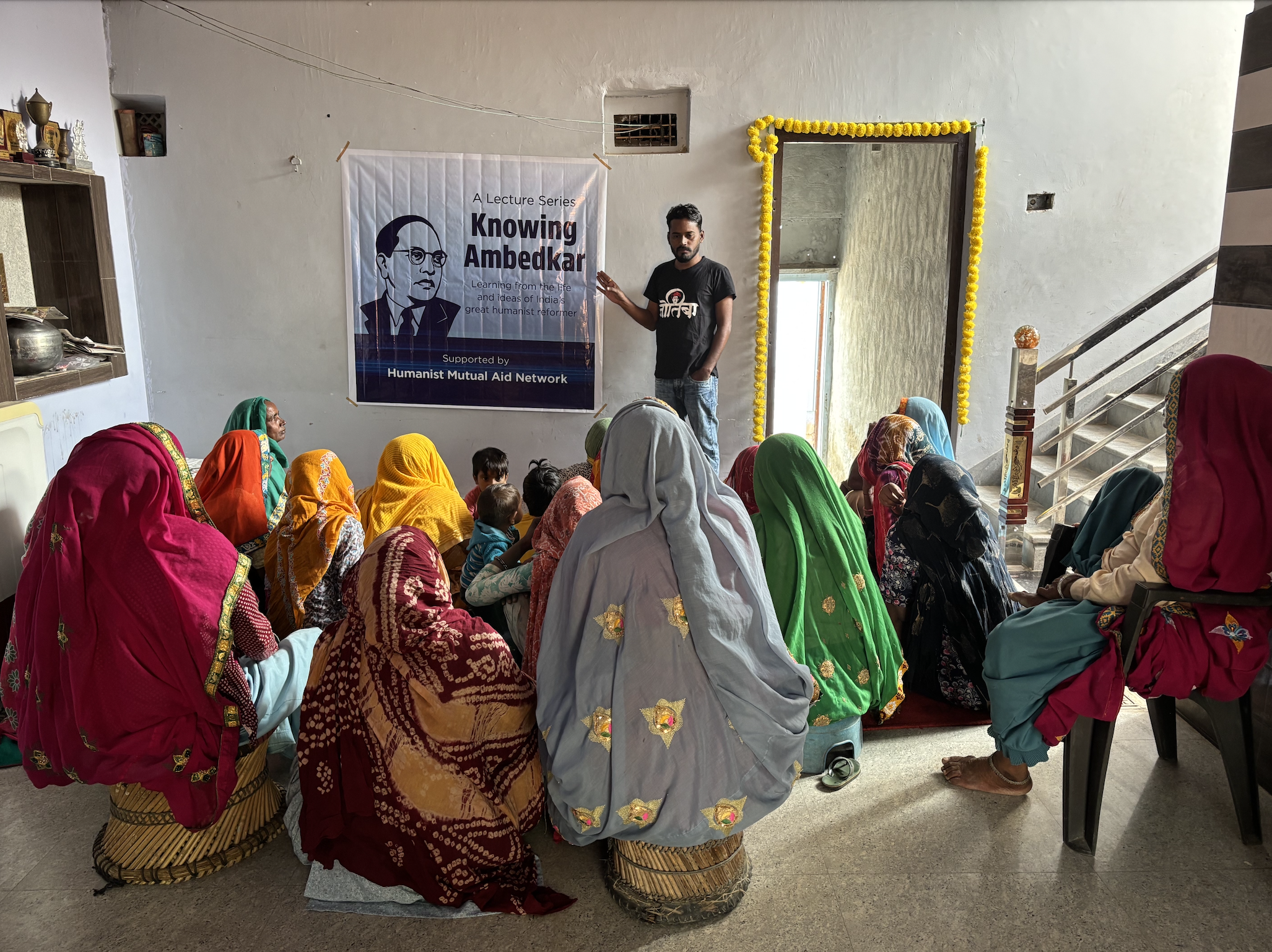
Ambedkar Workshop Held in Kanjro Ki Dhaani, Rajasthan
My name is Ravindra Dhanka, and I am a social activist from Rajasthan. With the support of Humanist Mutual Aid, I organized my first Ambedkar workshop in my village, Kanjro Ki Dhaani, Gopalpura Village, Kotputli-Behror District, Rajasthan. This workshop was very important to me because it is the beginning of a new awareness movement in my community.
For my first workshop, I decided to work only with the women and girls of my community. I chose to start with them because women face many struggles in society and their voices are often ignored. I strongly believe that real change in any community begins with women.
During the workshop, we discussed three main topics: the struggles of women in India, the thoughts of B. R. Ambedkar on women’s freedom, and the relevance of his ideas in today’s time. I explained that most people in our community had already heard the name of Dr. Ambedkar before, but they did not know much about his life, his struggles, and his ideas in depth. This workshop helped them understand him better and see why his thoughts are still so important for our lives today.
I spoke about how Dr. Ambedkar believed that without the freedom and education of women, no society can truly progress. We talked about issues such as lack of education, early marriage, financial dependence, domestic violence, and the extra pressure faced by women from marginalized communities.
An open discussion was held during the workshop, where many women and girls shared their personal experiences. For several of them, it was the first time they spoke openly in front of others. Some shared how they were forced to leave school early, some talked about family pressure, and some spoke about their hopes for their future. The discussion was emotional and honest. I could feel that the women were relieved to finally have a space where they could speak freely.
After the session ended, refreshments were provided to everyone. The women stayed back, talked among themselves, and continued the discussion informally. The program felt more like a community gathering than a formal meeting.
In the following days, the workshop became a topic of discussion in the village. Many people spoke about what they learned about Dr. Ambedkar and how the workshop helped them understand his ideas more clearly. Several families appreciated that such a program was organized in the village for the first time. Some villagers also showed interest in attending future workshops.
I would like to sincerely thank Hank for trusting me and making me a part of Humanist Mutual Aid. His support made this workshop possible, and I am very grateful for this opportunity. I feel proud and happy that I could organize this workshop for my community.
This was only the first step. My aim is to continue this work and organize more workshops in the future on education, rights, and social justice. This program has given me confidence and shown me that my community is ready to learn, speak, and move forward together.